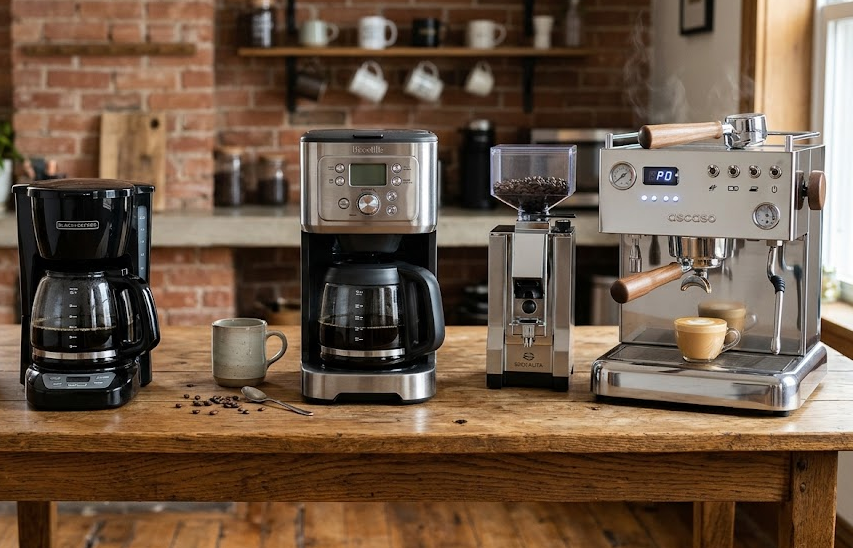
The best coffee maker is the one that matches your preferred coffee flavor, brewing habits, daily consumption, and budget.
Choosing a coffee maker can be surprisingly complicated. Some people want a rich, full-bodied cup of coffee every morning, while others prefer a clean, aromatic pour-over or a refreshing cold brew. Some prioritize convenience, while others enjoy experimenting with grind size, water temperature, and brewing time.
The modern coffee maker market offers a wide variety of brewing methods, including automatic drip coffee makers, French presses, pour-over brewers, cold brew makers, percolators, moka pots, and single-serve coffee makers.
Each method produces a different coffee experience. The differences are not limited to taste: brewing time, cleaning requirements, capacity, operating costs, and customization options can all influence your purchasing decision.
In this advanced SEE2GET buying guide, we’ll explore how to identify the best coffee maker for your needs, compare the most popular brewing methods, evaluate essential features, and understand which specifications genuinely matter.
Whether you’re a beginner, a coffee enthusiast, or a household looking for a reliable everyday coffee maker, this guide will help you make a smarter buying decision.
1. Start With Your Coffee Preferences
Before comparing brands, prices, or specifications, identify the type of coffee you enjoy drinking.
Different coffee makers are designed to produce different flavor profiles and beverage characteristics.
Which Coffee Maker Is Best for Your Favorite Coffee?
| Coffee Preference | Recommended Coffee Maker | Flavor Characteristics | Typical Price (USD) |
|---|---|---|---|
| Traditional black coffee | Automatic drip coffee maker | Balanced, clean, familiar | $40–$300 |
| Strong, full-bodied coffee | French press | Rich, heavy, textured | $20–$150 |
| Clean and aromatic coffee | Pour-over coffee maker | Bright, nuanced, clear | $10–$100 |
| Smooth, refreshing coffee | Cold brew maker | Mellow, concentrated, less sharp-tasting | $20–$150 |
| Strong, concentrated coffee | Moka pot | Intense, rich, espresso-like | $20–$100 |
| Coffee for several people | Large-capacity drip coffee maker | Consistent, convenient | $60–$400 |
| Single-cup coffee | Single-serve coffee maker | Consistent, convenient | $70–$300 |
| Traditional European coffee | Coffee percolator | Strong, robust | $25–$200 |
| Specialty coffee | Precision pour-over brewer | Highly customizable | $20–$400 |
| Coffee with minimal preparation | Programmable drip coffee maker | Convenient, consistent | $50–$300 |
Buying recommendation: If you enjoy traditional black coffee, an automatic drip coffee maker is an excellent starting point.
If you prefer a richer and heavier texture, consider a French press.
If aroma, flavor clarity, and experimentation are your priorities, a pour-over coffee maker may be a better choice.
For people who enjoy cold coffee throughout the year, a dedicated cold brew maker can offer excellent value.
2. Understand the Main Types of Coffee Makers
The brewing method is one of the most important factors influencing coffee flavor.
Each coffee maker uses a different approach to extracting soluble compounds from ground coffee.
Coffee Maker Comparison Table
| Coffee Maker Type | Ease of Use | Flavor Quality Potential | Customization | Cleaning | Typical Price |
|---|---|---|---|---|---|
| Automatic Drip Coffee Maker | 9/10 | 8/10 | 6/10 | 8/10 | $40–$400 |
| French Press | 8/10 | 8/10 | 8/10 | 6/10 | $20–$150 |
| Pour-Over Coffee Maker | 5/10 | 10/10 | 10/10 | 9/10 | $10–$400 |
| Cold Brew Coffee Maker | 8/10 | 8/10 | 7/10 | 7/10 | $20–$150 |
| Moka Pot | 7/10 | 8/10 | 7/10 | 8/10 | $20–$100 |
| Coffee Percolator | 8/10 | 6/10 | 5/10 | 7/10 | $25–$200 |
| Single-Serve Pod Coffee Maker | 10/10 | 6/10 | 3/10 | 9/10 | $70–$300 |
| Manual Coffee Dripper | 5/10 | 9/10 | 10/10 | 9/10 | $10–$60 |
Ratings indicate general category characteristics and potential performance. They are not independent laboratory test scores. Actual results depend on coffee quality, grinder performance, brewing technique, water, and the individual product.
Automatic Drip Coffee Makers: Best for Everyday Coffee
Automatic drip coffee makers are among the most practical options for everyday coffee preparation.
They work by heating water and distributing it over ground coffee. The brewed coffee then collects in a glass or thermal carafe.
Advantages:
- Simple operation.
- Consistent brewing.
- Suitable for multiple servings.
- Programmable preparation.
- Available in a wide range of prices.
Disadvantages:
- Limited control over extraction in basic models.
- Some glass-carafe models rely on heating plates.
- Lower-priced models may have inconsistent water distribution.
Best for: Families, offices, everyday coffee drinkers, and people who want convenient black coffee.
French Press: Best for Rich, Full-Bodied Coffee
The French press uses immersion brewing.
Ground coffee is steeped in hot water before a metal plunger separates the grounds from the beverage.
Because the metal filter allows more oils and fine particles to pass through, French press coffee generally has a fuller body than paper-filtered coffee.
Advantages:
- Affordable.
- No electricity required.
- Easy to operate.
- Excellent flavor customization.
- No disposable paper filters required.
Disadvantages:
- More sediment in the finished coffee.
- Requires manual preparation.
- Cleaning can be less convenient.
- Coffee can become over-extracted if left in contact with the grounds.
Best for: Coffee drinkers who prefer rich, textured coffee and enjoy manual brewing.
Pour-Over Coffee Makers: Best for Flavor and Precision
Pour-over coffee makers allow hot water to pass through ground coffee and a filter.
Popular designs include cone-shaped drippers, flat-bottom brewers, and integrated glass carafe systems.
The method offers considerable control over the brewing process.
Advantages:
- Excellent flavor clarity.
- High customization potential.
- Affordable entry price.
- Simple construction.
- Easy to clean.
Disadvantages:
- Requires more attention.
- Results depend on pouring technique.
- A separate kettle may be necessary.
- Usually less convenient for large batches.
Best for: Specialty coffee enthusiasts, people who enjoy experimenting, and users who prioritize flavor clarity.
Cold Brew Coffee Makers: Best for Cold Coffee
Cold brew makers use cold or room-temperature water to extract coffee over an extended period.
The process typically takes 8–24 hours, depending on the recipe and desired strength.
Advantages:
- Smooth flavor profile.
- Convenient batch preparation.
- Suitable for refrigerator storage.
- Excellent for iced coffee beverages.
Disadvantages:
- Long brewing time.
- Requires advance preparation.
- Concentrated coffee may need dilution.
- Cleaning the filter can be inconvenient.
Best for: Iced coffee enthusiasts, summer beverage lovers, and people who prefer preparing coffee in advance.
Moka Pots: Best for Strong, Concentrated Coffee
Moka pots use heated water and steam pressure to push water through ground coffee.
They produce a concentrated, intense beverage that can be used as a base for milk drinks.
Advantages:
- Compact design.
- Affordable.
- No electricity required for stovetop models.
- Durable construction.
- Produces strong coffee.
Disadvantages:
- Requires attention during brewing.
- Flavor can become bitter if overheated.
- Not equivalent to true espresso.
- Limited batch size.
Best for: People who enjoy strong coffee, compact brewing equipment, and traditional stovetop preparation.
3. Evaluate the Features That Actually Matter
Coffee maker manufacturers often promote advanced features.
However, not every feature improves the final beverage.
Some specifications have a direct impact on coffee quality, while others primarily improve convenience.
Advanced Coffee Maker Feature Comparison
| Feature | Importance Rating | What It Does | Who Benefits Most |
|---|---|---|---|
| Precise Brewing Temperature | 10/10 | Helps maintain appropriate extraction temperature | Specialty coffee drinkers |
| Adjustable Water Flow | 9/10 | Controls water delivery during brewing | Pour-over enthusiasts |
| Bloom Function | 9/10 | Allows initial wetting and gas release from fresh coffee | Specialty coffee drinkers |
| Built-In Burr Grinder | 9/10 | Grinds beans immediately before brewing | Fresh coffee enthusiasts |
| Adjustable Brew Strength | 8/10 | Changes brewing parameters or coffee-to-water ratio | Everyday users |
| Programmable Timer | 8/10 | Schedules coffee preparation | Busy households |
| Thermal Carafe | 9/10 | Maintains coffee temperature without a hotplate | People who drink coffee over several hours |
| Large Water Reservoir | 8/10 | Reduces refilling frequency | Families and offices |
| Multiple Brew Sizes | 8/10 | Supports different serving quantities | Multi-user households |
| Reusable Coffee Filter | 7/10 | Reduces disposable filter consumption | Environmentally conscious users |
| Automatic Cleaning Alerts | 8/10 | Helps users maintain the coffee maker | Frequent coffee drinkers |
| Adjustable Water Hardness | 7/10 | Supports water management in compatible models | Users with hard water |
| Smart Connectivity | 5/10 | Enables app-based controls or notifications | Technology enthusiasts |
| Touchscreen Interface | 5/10 | Simplifies access to settings | Convenience-focused users |
Ratings are editorial assessments of general feature usefulness, not tested scores.
Brewing Temperature: One of the Most Important Specifications
Water temperature significantly affects coffee extraction.
For conventional hot coffee brewing, a water temperature around 195–205°F (90–96°C) is a widely used reference range.
If the water is too cool, the coffee may taste weak or under-extracted.
If the water is excessively hot or the brewing process is poorly controlled, the result may become harsh or bitter.
When evaluating a coffee maker, look for:
- Stable brewing temperature.
- Consistent heating performance.
- Appropriate water distribution.
- Temperature control, if available.
- Compatibility with your preferred roast level.
Temperature control is particularly valuable for people who regularly experiment with different coffee beans.
Built-In Grinder: Is It Worth It?
Freshly ground coffee generally provides a more aromatic experience than coffee that has been ground and stored for an extended period.
A coffee maker with a built-in grinder can simplify preparation by combining grinding and brewing in one appliance.
However, grinder quality matters.
| Grinder Type | Consistency | Adjustability | Recommendation |
|---|---|---|---|
| Blade Grinder | 4/10 | 3/10 | Basic use only |
| Entry-Level Burr Grinder | 7/10 | 6/10 | Good for everyday coffee |
| Conical Burr Grinder | 8/10 | 8/10 | Excellent for most home users |
| Flat Burr Grinder | 9/10 | 9/10 | Suitable for advanced enthusiasts |
A quality burr grinder is generally preferable to a blade grinder because it produces more uniform particle sizes.
For people who already own a good grinder, purchasing a coffee maker without an integrated grinder can be a better investment.
Thermal Carafe vs. Glass Carafe
Carafe design is an important consideration for anyone who regularly prepares several cups of coffee.
| Attribute | Glass Carafe | Thermal Carafe |
|---|---|---|
| Heat Retention | Moderate | Excellent |
| Heating Plate | Usually required | Usually unnecessary |
| Coffee Flavor Over Time | May deteriorate with prolonged heating | Generally better preserved |
| Visibility | Excellent | Limited |
| Cleaning | Often easier | Depends on design |
| Price | Usually lower | Usually higher |
| Best For | Immediate consumption | Extended coffee drinking |
Our recommendation: Choose a thermal carafe if you regularly drink coffee over several hours.
A glass carafe is a practical option if you usually consume the entire batch shortly after brewing.
4. Choose the Right Coffee Maker Based on Your Lifestyle
The ideal coffee maker depends on how you use it.
A person preparing one cup every morning has different requirements from a household preparing coffee for several people.
Lifestyle-Based Recommendations
| User Profile | Recommended Coffee Maker | Essential Features | Suggested Budget |
|---|---|---|---|
| Beginner | Automatic drip coffee maker | Simple controls, reliable brewing | $50–$150 |
| Busy Professional | Programmable drip coffee maker | Timer, thermal carafe | $100–$300 |
| Coffee Enthusiast | Precision pour-over brewer | Temperature control, flow control | $50–$400 |
| Family Household | Large-capacity drip coffee maker | 10–14 cup capacity | $80–$300 |
| Strong Coffee Lover | French press or moka pot | Durable construction | $20–$100 |
| Iced Coffee Enthusiast | Cold brew coffee maker | Large capacity, easy filtration | $30–$150 |
| Small Apartment Owner | Compact drip coffee maker or French press | Small footprint | $20–$150 |
| Office Environment | Large-capacity drip coffee maker | Thermal carafe, fast brewing | $150–$500 |
| Specialty Coffee Beginner | Manual pour-over brewer | Simple design, reusable components | $20–$60 |
| Premium Coffee Enthusiast | Precision drip coffee maker | Advanced brewing controls | $300–$500 |
Consider Your Daily Coffee Consumption
Capacity is another important buying consideration.
| Daily Consumption | Recommended Coffee Maker | Important Considerations |
|---|---|---|
| 1 cup | Single-serve or manual pour-over | Minimal waste |
| 2–3 cups | French press or small drip coffee maker | Convenient batch size |
| 4–6 cups | Medium-capacity drip coffee maker | Reservoir capacity |
| 7–10 cups | Large-capacity drip coffee maker | Thermal carafe |
| 10+ cups | High-capacity drip coffee maker | Durability and brewing speed |
One important detail: manufacturers often define a coffee maker’s “cup” as approximately 5–6 ounces rather than a standard 8-ounce cup.
A 12-cup coffee maker may therefore produce approximately 60–72 ounces of coffee, depending on the manufacturer’s measurement.
5. Compare the Best Coffee Makers by Budget
Price is important, but expensive coffee makers are not automatically better.
The most appropriate model depends on your brewing preferences and the features you actually need.
Coffee Maker Price and Performance Comparison
| Model | Type | Best For | Main Features | Estimated Price (USD) |
|---|---|---|---|---|
| Bodum Chambord | French Press | Budget-conscious coffee lovers | Classic design, metal filter | $30–$50 |
| Hario V60 02 | Pour-Over | Beginners and enthusiasts | Simple cone design, excellent control | $10–$30 |
| Chemex Classic 8-Cup | Pour-Over | Clean, aromatic coffee | Glass carafe, thick paper filters | $45–$60 |
| OXO Brew 8-Cup | Drip Coffee Maker | Everyday premium coffee | Brew-size flexibility, controlled brewing | $150–$250 |
| Ninja 12-Cup Programmable CE251 | Drip Coffee Maker | Families | Programmable brewing, large capacity | $80–$120 |
| Zojirushi Zutto 5-Cup | Drip Coffee Maker | Small households | Compact design | $70–$100 |
| Technivorm Moccamaster KBGV Select | Drip Coffee Maker | Premium coffee quality | Consistent brewing, durable construction | $350–$400 |
| Fellow Aiden Precision Coffee Maker | Drip Coffee Maker | Specialty coffee enthusiasts | Programmable brewing, precision controls | $300–$400 |
| OXO Cold Brew Coffee Maker | Cold Brew | Cold coffee lovers | Concentrate preparation, filtration | $40–$60 |
| Toddy Cold Brew System | Cold Brew | Large-batch cold brew | Immersion brewing, concentrate | $40–$60 |
| Bialetti Moka Express | Moka Pot | Strong coffee enthusiasts | Stovetop brewing, classic design | $30–$60 |
Prices are approximate U.S. reference prices and may vary by size, configuration, retailer, and promotional discounts.
Which Coffee Maker Offers the Best Value?
Under $50
Manual coffee makers offer excellent value.
French presses, moka pots, and pour-over drippers provide a practical way to prepare quality coffee without expensive equipment.
$50–$150
This category is ideal for beginners and everyday coffee drinkers.
You can find compact drip coffee makers, programmable models, and quality manual brewing equipment.
$150–$300
This price range offers a strong combination of convenience and brewing performance.
Look for temperature control, thermal carafes, improved water distribution, and programmable features.
$300–$500
Premium drip coffee makers and precision brewers become available.
These models are especially attractive to enthusiasts who want more consistent extraction and greater control over brewing parameters.
Above $500
At this level, evaluate the additional benefits carefully.
Consider whether advanced customization, premium construction, integrated grinding, or specialized brewing capabilities justify the additional investment.
For many users, a $150–$300 coffee maker can provide excellent everyday performance.
6. How to Evaluate Coffee Maker Ratings
Customer reviews and professional ratings can help identify suitable products, but they should not be interpreted as universal indicators of quality.
A coffee maker rated highly for convenience may not be the best choice for flavor experimentation.
Similarly, a manual brewer with excellent coffee quality potential may receive lower usability ratings.
Recommended SEE2GET Coffee Maker Evaluation Criteria
| Evaluation Criterion | Weight | What to Evaluate |
|---|---|---|
| Coffee Flavor and Extraction | 30% | Taste, aroma, consistency |
| Ease of Use | 15% | Preparation, controls, convenience |
| Brewing Performance | 15% | Temperature, water distribution, brewing time |
| Build Quality | 15% | Materials, durability, construction |
| Maintenance | 10% | Cleaning, descaling, accessibility |
| Value for Money | 10% | Performance relative to price |
| Design and Ergonomics | 5% | Size, usability, appearance |
Example: Comparing Two Coffee Makers
| Criterion | Coffee Maker A | Coffee Maker B |
|---|---|---|
| Coffee Flavor | 9/10 | 8/10 |
| Ease of Use | 6/10 | 9/10 |
| Brewing Performance | 9/10 | 8/10 |
| Build Quality | 8/10 | 8/10 |
| Maintenance | 7/10 | 9/10 |
| Value for Money | 9/10 | 7/10 |
| Design | 7/10 | 9/10 |
| Weighted Overall Rating | 8.2/10 | 8.3/10 |
Illustrative comparison using the evaluation framework above. These scores are hypothetical and do not represent independently tested products.
Coffee Maker A may be preferable for someone who prioritizes brewing quality and value.
Coffee Maker B may be more suitable for someone who values convenience, simple operation, and easy maintenance.
This demonstrates why an overall rating should always be considered alongside your personal preferences.
7. Understand the Long-Term Cost of Owning a Coffee Maker
The initial purchase price is only one component of the total cost of ownership.
Coffee beans, paper filters, cleaning products, and replacement components can influence the cost of preparing coffee over several years.
Estimated Annual Operating Costs
| Expense | Drip Coffee Maker | French Press | Pour-Over | Cold Brew Maker |
|---|---|---|---|---|
| Coffee | $150–$500 | $150–$500 | $150–$500 | $150–$500 |
| Paper Filters | $20–$80 | $0 | $20–$80 | $0–$40 |
| Cleaning Products | $20–$60 | $10–$30 | $10–$30 | $10–$40 |
| Descaling | $10–$40 | $0 | $0 | $0 |
| Maintenance | $10–$100 | $5–$30 | $5–$30 | $5–$40 |
| Estimated Total | $210–$780 | $165–$560 | $185–$640 | $165–$620 |
Illustrative estimates assuming approximately two coffee servings per day. Coffee costs vary depending on bean quality, serving size, and preparation method. Equipment maintenance costs are not guaranteed.
Why Cost Per Cup Matters
Consider two coffee makers:
- Coffee Maker A costs $50.
- Coffee Maker B costs $250.
Suppose Coffee Maker B allows you to prepare coffee using a more economical brewing setup, reducing your average cost by $0.10 per serving.
At two cups per day:
$0.10 × 730 servings = $73 in annual savings.
Over five years, the savings could reach $365.
However, this calculation does not account for maintenance, coffee quality, or electricity.
The important lesson is that a coffee maker should be evaluated according to both its purchase price and its expected operating costs.
8. Consider Size, Capacity, and Kitchen Space
Coffee makers vary considerably in size.
A compact French press may require very little storage space, while a premium drip coffee maker with a large thermal carafe can occupy a significant portion of your countertop.
Coffee Maker Size and Capacity Comparison
| Coffee Maker Type | Typical Capacity | Countertop Space | Best For |
|---|---|---|---|
| French Press | 350–1,000 ml | Minimal | Individual servings |
| Pour-Over Dripper | 250–1,000 ml | Minimal | One to several cups |
| Compact Drip Coffee Maker | 500–1,000 ml | Small | Small households |
| Standard Drip Coffee Maker | 1–1.8 L | Medium | Everyday use |
| Large Drip Coffee Maker | 1.5–2.5 L | Large | Families and offices |
| Cold Brew Maker | 500 ml–2 L | Medium | Batch preparation |
Before purchasing, consider:
- Available countertop space.
- Storage requirements.
- Carafe dimensions.
- Reservoir accessibility.
- Ease of filling.
- Cleaning requirements.
A coffee maker that fits your kitchen comfortably is more likely to become a practical part of your daily routine.
9. Maintenance and Reliability: What Should You Check?
Maintenance is one of the most overlooked factors when purchasing a coffee maker.
Even a premium coffee maker can produce disappointing results if it is not properly cleaned.
Essential Maintenance Features
| Feature | Importance Rating | Benefit |
|---|---|---|
| Removable Filter Basket | 9/10 | Simplifies cleaning |
| Dishwasher-Safe Components | 9/10 | Reduces cleaning effort |
| Descaling Alerts | 8/10 | Helps maintain performance |
| Accessible Water Reservoir | 8/10 | Simplifies filling and cleaning |
| Thermal Carafe with Wide Opening | 8/10 | Easier cleaning |
| Automatic Cleaning Program | 8/10 | Reduces maintenance effort |
| Replaceable Filters | 7/10 | Supports long-term usability |
| Durable Glass or Stainless Steel | 9/10 | Improves longevity potential |
What to Check Before Buying
Look for coffee makers with:
- Easily removable components.
- Clear cleaning instructions.
- Available replacement parts.
- Reliable warranty coverage.
- Durable materials.
- Reasonable maintenance requirements.
Water quality also matters.
Hard water can accelerate mineral buildup in electric coffee makers.
Depending on the product, using filtered water and following the manufacturer’s descaling recommendations can help maintain brewing performance.
10. Advanced Features: Which Ones Are Worth Paying For?
Modern coffee makers increasingly include features designed to improve extraction consistency and convenience.
However, not all advanced features are equally valuable.
Premium Coffee Maker Feature Comparison
| Feature | Practical Benefit | Worth Paying More? |
|---|---|---|
| PID Temperature Control | Improves temperature regulation | Yes, for specialty coffee |
| Adjustable Water Flow | Enables more precise brewing | Yes, for enthusiasts |
| Bloom Function | Improves the initial wetting stage | Yes, for freshly roasted coffee |
| Automatic Brewing Schedule | Prepares coffee at a selected time | Yes, for busy households |
| Thermal Carafe | Maintains coffee temperature | Yes, for extended consumption |
| Integrated Burr Grinder | Combines grinding and brewing | Depends on grinder quality |
| Multiple Brew Profiles | Saves personalized brewing settings | Yes, for experimentation |
| Smart Connectivity | Adds app-based controls | Optional |
| Automatic Water Hardness Settings | Supports water management | Useful in hard-water areas |
| Cold Brew Mode | Expands beverage options | Only if frequently used |
PID Temperature Control
PID stands for proportional-integral-derivative control.
In coffee makers, PID-based systems can help regulate heating temperature.
Temperature stability can improve brewing consistency, particularly when preparing specialty coffee.
However, the presence of PID control alone does not guarantee excellent coffee.
Water distribution, coffee quality, grind size, and brewing time remain important.
Bloom Function
Freshly roasted coffee contains carbon dioxide.
When hot water first contacts the grounds, some of this gas is released.
A bloom phase allows the coffee to become evenly wetted before the main extraction begins.
This feature can be particularly useful for freshly roasted coffee and specialty brewing.
Integrated Grinder vs. Separate Grinder
| Attribute | Integrated Grinder | Separate Grinder |
|---|---|---|
| Convenience | Excellent | Moderate |
| Countertop Space | Efficient | Requires additional space |
| Grinder Replacement | More difficult | Easier |
| Customization | Depends on model | Often greater |
| Cleaning | Can be complicated | Generally simpler |
| Upgrade Potential | Limited | Excellent |
A separate grinder can be a better long-term investment for enthusiasts who want to improve their coffee preparation over time.
11. Common Coffee Maker Buying Mistakes
Avoid these mistakes when selecting your next coffee maker.
Mistake 1: Choosing the Most Expensive Model
Higher prices do not automatically guarantee better coffee.
An expensive precision brewer may offer little practical benefit to someone who simply wants a convenient morning cup.
Mistake 2: Ignoring Brewing Method
A French press, pour-over brewer, and automatic drip coffee maker produce different results.
Choose according to your preferred flavor and texture.
Mistake 3: Buying Excessive Capacity
A large coffee maker can waste coffee if you only prepare one cup at a time.
Choose a capacity that matches your daily consumption.
Mistake 4: Overlooking Grinder Quality
Fresh grinding can improve aroma and flavor.
However, an integrated grinder is only worthwhile if it performs well.
Mistake 5: Ignoring Carafe Design
A thermal carafe can preserve coffee temperature more effectively than a glass carafe placed on a hotplate.
Consider how long you typically drink coffee after brewing.
Mistake 6: Underestimating Cleaning Requirements
Coffee oils and mineral deposits can accumulate over time.
Choose a coffee maker that you can clean comfortably.
Mistake 7: Buying Features You Will Never Use
Smart connectivity, multiple brewing profiles, and advanced controls can increase the purchase price.
Only pay for features that meaningfully improve your coffee experience.
12. The SEE2GET Coffee Maker Buying Checklist
Before purchasing a coffee maker, use this checklist to identify your requirements.
| Buying Consideration | Recommended Question |
|---|---|
| Coffee Preference | Do I prefer black coffee, strong coffee, or cold brew? |
| Brewing Method | Do I want automatic or manual preparation? |
| Daily Consumption | How many cups do I prepare each day? |
| Capacity | Is the carafe large enough for my household? |
| Convenience | Do I need programmable brewing? |
| Flavor | Does the brewing method match my taste preferences? |
| Grinder | Do I need an integrated grinder? |
| Temperature | Does the coffee maker maintain an appropriate brewing temperature? |
| Carafe | Should I choose glass or thermal? |
| Maintenance | How easy is the coffee maker to clean? |
| Kitchen Space | Will it fit comfortably on my countertop? |
| Operating Costs | How much will coffee and filters cost annually? |
| Reliability | Are replacement parts and warranty support available? |
| Budget | Does the coffee maker offer good value for money? |
Final Verdict: Which Coffee Maker Should You Buy?
There is no universally best coffee maker.
The ideal choice depends on your brewing preferences, lifestyle, and budget.
Our Recommendations
| Your Priority | Recommended Coffee Maker | Suggested Budget |
|---|---|---|
| Best for Beginners | Automatic Drip Coffee Maker | $50–$150 |
| Best for Everyday Black Coffee | Quality Drip Coffee Maker | $100–$300 |
| Best for Rich, Full-Bodied Coffee | French Press | $20–$100 |
| Best for Flavor Precision | Pour-Over Coffee Maker | $20–$100 |
| Best for Cold Coffee | Cold Brew Coffee Maker | $30–$150 |
| Best for Strong Coffee | Moka Pot | $30–$80 |
| Best for Families | Large-Capacity Drip Coffee Maker | $100–$300 |
| Best for Small Kitchens | Compact Drip Coffee Maker or French Press | $20–$150 |
| Best for Specialty Coffee | Precision Drip Coffee Maker | $300–$500 |
| Best for Convenience | Programmable Drip Coffee Maker | $100–$300 |
Our Buying Advice
If you want a reliable everyday coffee maker, a quality automatic drip coffee maker is an excellent choice.
If you prefer rich, full-bodied coffee, consider a French press.
If you enjoy experimenting with flavor, aroma, and extraction, a pour-over coffee maker provides excellent control.
If cold coffee is your preferred beverage, a cold brew maker can simplify preparation and provide consistent results.
If you enjoy strong coffee and have limited kitchen space, a moka pot is a practical and affordable option.
Ultimately, the best coffee maker is not necessarily the one with the most features or the highest price.
It is the one that consistently prepares the coffee you enjoy, fits your daily routine, and provides excellent value over its lifetime.
Before making your final purchase, prioritize brewing quality, ease of use, capacity, maintenance, and total ownership cost. These factors will have a greater impact on your daily coffee experience than most marketing features.
A well-chosen coffee maker can improve your morning routine, help you enjoy better coffee at home, and provide years of satisfying use.
The key is to choose according to your preferences — not simply according to the product’s price or popularity.