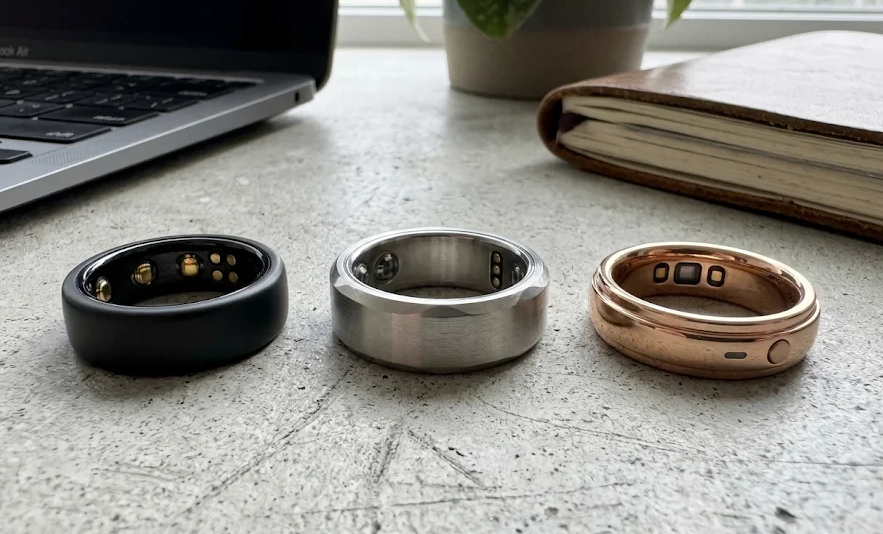
Wearable technology is moving beyond smartwatches and fitness bands. One of the most interesting developments is the smart ring: a compact electronic device designed to sit on your finger while quietly collecting information about your daily activity, sleep patterns, heart rate, and other wellness indicators.
Unlike traditional wearables, smart rings generally have no screen, few physical controls, and minimal interaction throughout the day. Instead, they collect information through built-in sensors and transfer it to a smartphone application, where users can review measurements, trends, and personalized insights.
The appeal is straightforward: a smart ring offers many of the tracking capabilities associated with larger wearables in a considerably smaller package.
However, smart rings are not automatically better than smartwatches or fitness trackers. They have limitations involving workout tracking, display functionality, battery management, measurement accuracy, and software subscriptions.
The right purchase depends on what you want to monitor, how much you are prepared to spend, which smartphone you use, and whether you value convenience over advanced fitness functionality.
This guide examines how smart rings work, who can benefit from them, which features matter, and how to identify the best option for your requirements.
1. What Is a Smart Ring?
A smart ring is a wearable electronic device shaped like a conventional ring but equipped with miniature sensors, wireless connectivity, a rechargeable battery, and supporting software.
Its primary purpose is to collect physiological and movement-related information throughout the day and night.
Most smart rings communicate with a smartphone through Bluetooth Low Energy (BLE). The companion application processes the collected information and presents it through charts, daily summaries, historical trends, and recommendations.
Unlike smartwatches, smart rings typically do not include displays, speakers, or extensive interactive controls.
Instead, they are designed for passive tracking: wear the device, allow it to collect information, and review the results through your phone.
How Does a Smart Ring Work?
Smart rings combine several technologies to monitor different aspects of daily activity.
| Technology | What It Measures | Why It Matters |
|---|---|---|
| PPG sensors | Heart rate and heart-rate variability | Helps monitor cardiovascular trends and recovery-related indicators |
| Skin temperature sensors | Changes in skin temperature | Helps identify deviations from personal temperature patterns |
| Accelerometer | Movement and acceleration | Supports step counting, activity recognition, and sleep analysis |
| Gyroscope (selected models) | Rotational movement | Helps interpret movement and activity patterns |
| Infrared sensors | Blood oxygen estimates in supported devices | Provides an additional wellness measurement |
| Bluetooth Low Energy | Wireless communication | Transfers collected information to a smartphone |
| Rechargeable battery | Device power | Supports continuous tracking between charging sessions |
Important: Sensor availability varies by manufacturer and model. Not every smart ring includes every technology listed above.
Understanding the Main Measurements
Heart Rate
Optical sensors use light to estimate heart rate by detecting changes in blood volume beneath the skin.
Smart rings can provide continuous or periodic heart-rate measurements, depending on their software and operating mode.
Heart-Rate Variability (HRV)
HRV measures variations in the time between consecutive heartbeats.
It is commonly used to observe changes in physiological patterns over time. Some smart rings incorporate HRV into sleep, recovery, and wellness summaries.
HRV is not a standalone measurement of fitness or health.
Sleep Tracking
Sleep tracking is one of the most important features of the smart ring category.
Depending on the model, the device can estimate:
- Total sleep duration.
- Sleep and wake periods.
- Sleep consistency.
- Estimated sleep stages.
- Nighttime heart rate.
- Overnight HRV.
- Changes in skin temperature.
These measurements are estimates rather than direct recordings of brain activity. A smart ring cannot replace clinical sleep testing.
Skin Temperature Trends
Some rings measure skin temperature during sleep and compare readings with an individual’s established baseline.
These measurements can provide useful context about changes in normal patterns, but they should not be interpreted as medical temperature readings.
Activity Tracking
Smart rings use movement sensors to estimate daily steps, activity levels, and periods of movement.
Some models automatically recognize selected activities, although their workout detection and exercise metrics are generally less comprehensive than those of dedicated sports watches.
2. Who Needs a Smart Ring?
A smart ring is most useful for someone who wants convenient, continuous wellness tracking without wearing a smartwatch.
It is not an essential device for everyone.
Before purchasing one, consider whether the information it collects will genuinely improve your understanding of daily habits or whether a simpler wearable would accomplish the same objective.
Main User Groups
| User Type | Potential Benefits | Priority Features | Recommendation |
|---|---|---|---|
| People interested in sleep | Overnight measurements and sleep-pattern summaries | Sleep tracking, HRV, temperature trends | Excellent fit |
| Everyday technology users | Passive tracking without a screen | Comfort, battery life, app usability | Good fit |
| Fitness enthusiasts | Additional recovery and activity information | Heart rate, activity recognition, integrations | Good as a secondary device |
| Frequent travelers | Compact wearable with relatively infrequent charging | Battery life, charging case, durability | Good fit |
| Smartwatch users | Additional overnight tracking while using a watch during the day | Smartphone compatibility, data integration | Depends on existing ecosystem |
| Privacy-conscious users | Potentially convenient tracking with manageable data-sharing settings | Encryption, privacy controls, data export | Requires careful research |
| Competitive athletes | Supplementary recovery information | Sensor quality, integrations | Not a replacement for a sports watch |
Who Probably Does Not Need One?
A smart ring may not be worthwhile if:
- You only want to count daily steps.
- You already own a smartwatch that provides the measurements you need.
- You require detailed GPS-based exercise tracking.
- You expect medical-grade health measurements.
- You dislike wearing jewelry continuously.
- You are uncomfortable storing personal wellness information in an application.
- You do not want to pay recurring software fees.
There is also an important distinction between adults and younger users. Some smart-ring services have minimum-age requirements or restrictions on certain health features. Families should check the manufacturer’s current eligibility, privacy, and account policies before purchasing a device for a younger user.
Our verdict: Smart rings make the most sense for people who value passive sleep and wellness tracking, rather than users looking for a complete replacement for a smartwatch.
3. Smart Ring vs. Smartwatch vs. Fitness Tracker
Smart rings compete with established wearable categories, but their strengths are different.
| Feature | Smart Ring | Smartwatch | Fitness Tracker |
|---|---|---|---|
| Compact design | Excellent | Moderate | Good |
| Overnight comfort | Often excellent | Depends on size | Depends on design |
| Sleep tracking | Strong | Strong | Strong |
| Heart-rate monitoring | Good for trends | Often more versatile | Good |
| Workout tracking | Basic to moderate | Advanced | Moderate to advanced |
| Built-in GPS | Generally unavailable | Available on selected models | Available on selected models |
| Screen | No | Yes | Usually yes |
| Notifications | Generally unavailable | Yes | Usually available |
| Battery life | Typically several days | Often one to several days | Several days to weeks |
| Charging convenience | Dedicated charger or case | Charging cable or dock | Charging cable or dock |
| Everyday interaction | Minimal | Extensive | Moderate |
| Medical functionality | Limited | Model-dependent | Limited |
Which Wearable Should You Choose?
Choose a smart ring if: Your priorities are overnight comfort, passive tracking, discreet design, and longer intervals between charges.
Choose a smartwatch if: You need notifications, navigation, exercise tools, GPS, interactive applications, and more detailed sports functionality.
Choose a fitness tracker if: You want practical activity monitoring without paying premium prices for smartwatch features.
A smart ring and smartwatch can also complement one another, although this combination increases the total purchase cost.
4. The Best Smart Rings to Consider
The smart-ring market includes several established manufacturers with different approaches to hardware, software, and pricing.
The following comparison focuses on major products and their intended use cases.
Top Smart Rings Compared
| Smart Ring | Best For | Approximate Starting Price (USD) | Subscription | Main Advantage |
|---|---|---|---|---|
| Oura Ring 5 | Overall wellness tracking | $399 | Yes | Advanced wellness insights |
| Samsung Galaxy Ring | Samsung ecosystem users | $399.99 | No | Integration with Samsung Health |
| RingConn Gen 2 Air | Value and simplicity | $199 | No | Affordable subscription-free tracking |
| Ultrahuman Ring Pro | Subscription-free wellness tracking | Check current US pricing | No standard membership fee | Detailed software insights |
| Oura Ring 4 | Established premium alternative | $349 | Yes | Mature tracking platform |
Pricing is indicative US-market pricing, not a guaranteed live retail quotation. Special finishes, promotions, taxes, and retailer pricing can change the final amount. Confirm the exact model and price before purchasing.
4.1 Oura Ring 5 – Best Overall Premium Option
Editorial rating: 9.2/10
The Oura Ring 5 represents the premium end of the smart-ring market.
Oura’s main strength is its combination of sensor technology, sleep analysis, wellness insights, and an established companion application.
The device is designed to collect information continuously and transform it into understandable summaries.
Main features:
- Heart-rate monitoring.
- Heart-rate variability.
- Sleep analysis.
- Skin temperature trends.
- Activity monitoring.
- Blood oxygen measurements.
- Personalized wellness insights.
- Smartphone application integration.
Advantages:
- Comprehensive wellness platform.
- Strong emphasis on sleep analysis.
- Detailed historical trends.
- Established software ecosystem.
- Discreet design.
Disadvantages:
- Premium purchase price.
- Recurring membership cost.
- Not designed to replace advanced sports watches.
- Some features depend on software subscriptions.
Best for: Buyers who prioritize detailed wellness insights and are comfortable paying for an ongoing membership.
4.2 Samsung Galaxy Ring – Best for Samsung Users
Editorial rating: 8.8/10
Samsung approaches smart rings through its broader Galaxy ecosystem.
The Galaxy Ring combines a compact titanium design with health and activity measurements integrated into Samsung Health.
It is particularly attractive to people who already use compatible Samsung smartphones and other Galaxy devices.
Main features:
- Heart-rate monitoring.
- Sleep tracking.
- Skin temperature measurements.
- Activity tracking.
- Automatic wellness summaries.
- Charging case.
- Integration with Samsung Health.
Advantages:
- No standard monthly subscription.
- Convenient charging case.
- Lightweight construction.
- Strong integration with compatible Galaxy devices.
- Straightforward companion application.
Disadvantages:
- Best experience is tied to Samsung’s ecosystem.
- Android compatibility does not mean full compatibility with every phone.
- Limited functionality compared with advanced sports watches.
- Some health insights depend on compatible Samsung devices and services.
Best for: Existing Samsung users who want an additional wearable without adding another monthly subscription.
4.3 RingConn Gen 2 Air – Best Value
Editorial rating: 8.7/10
RingConn focuses on practical functionality and subscription-free access to its core tracking features.
The Gen 2 Air is particularly interesting for buyers who want to explore smart rings without entering the premium pricing category.
Its appeal comes from a relatively accessible purchase price and a feature set centered on everyday wellness monitoring.
Main features:
- Sleep tracking.
- Heart-rate monitoring.
- HRV measurements.
- Activity tracking.
- Temperature trends.
- Companion application.
- Multi-day battery life.
Advantages:
- Affordable starting price.
- No standard monthly subscription.
- Lightweight design.
- Useful everyday wellness measurements.
- Competitive battery-life specifications.
Disadvantages:
- Less comprehensive software insights than premium competitors.
- Workout tracking is not its strongest feature.
- App experience may not appeal to everyone.
- Limited advanced sports functionality.
Best for: First-time buyers who want a practical smart ring without recurring membership costs.
4.4 Ultrahuman Ring Pro – Best for Subscription-Free Insights
Editorial rating: 8.6/10
Ultrahuman has developed a distinctive approach to wearable wellness technology.
Its software emphasizes sleep, movement, recovery-related patterns, and daily behavioral insights.
The company’s product ecosystem is designed to help users understand how different daily habits relate to their recorded measurements.
Main features:
- Sleep monitoring.
- Heart-rate measurements.
- HRV tracking.
- Skin temperature trends.
- Activity tracking.
- Personalized software insights.
- Wellness-oriented integrations.
Advantages:
- No standard recurring membership requirement for core ring insights.
- Detailed wellness-oriented software.
- Useful historical measurements.
- Attractive alternative to subscription-based competitors.
Disadvantages:
- Advanced features and integrations vary by region.
- Some additional services may have separate charges.
- The application can feel more complex than simpler alternatives.
- Availability and pricing should be verified before ordering.
Best for: Buyers interested in detailed wellness information who prefer avoiding mandatory monthly memberships.
4.5 Oura Ring 4 – Best Established Alternative
Editorial rating: 8.9/10
Although newer hardware is available, the Oura Ring 4 remains a relevant option for buyers who want a mature platform at a potentially lower entry price.
It offers a titanium construction, established sleep tracking, heart-rate measurements, and extensive software support.
Advantages:
- Established companion application.
- Broad wellness tracking.
- Compatibility with iOS and Android.
- Multiple finishes.
- Mature software ecosystem.
Disadvantages:
- Subscription required for full functionality.
- Older hardware compared with the newer generation.
- Premium pricing remains a consideration.
Best for: Buyers who find a good deal on the previous generation and do not need the newest hardware.
5. Editorial Ratings: How the Main Options Compare
The following scores are SEE2GET editorial assessments based on product positioning, feature coverage, subscription structure, usability considerations, and value.
They are not laboratory measurements or aggregated customer-review scores.
| Product | Overall Rating | Sleep Tracking | Everyday Comfort | Software | Value |
|---|---|---|---|---|---|
| Oura Ring 5 | 9.2/10 | 9.6 | 9.2 | 9.6 | 8.0 |
| Oura Ring 4 | 8.9/10 | 9.4 | 9.0 | 9.5 | 7.8 |
| Samsung Galaxy Ring | 8.8/10 | 8.7 | 9.2 | 8.8 | 8.5 |
| RingConn Gen 2 Air | 8.7/10 | 8.4 | 8.9 | 8.1 | 9.3 |
| Ultrahuman Ring Pro | 8.6/10 | 8.8 | 8.8 | 9.0 | 8.6 |
How to interpret these ratings:
- Overall Rating: Our assessment of the complete product experience.
- Sleep Tracking: Assessment of sleep-focused functionality and reporting.
- Everyday Comfort: Design, weight, and suitability for continuous wear.
- Software: Application experience, data presentation, and insights.
- Value: Features relative to purchase and ongoing costs.
Ratings should not be interpreted as proof that one device produces medically more accurate measurements than another.
6. How to Choose the Best Smart Ring: 10 Important Buying Factors
Choosing a smart ring involves more than comparing prices or counting sensors.
The quality of the hardware, software, sizing system, and long-term ownership experience can make a substantial difference.
Factor 1: Sensor Quality and Measurement Reliability
The sensors are the foundation of a smart ring.
However, having more sensors does not automatically mean better measurements.
Consider:
- Heart-rate measurement consistency.
- HRV measurement availability.
- Temperature-trend monitoring.
- Sleep tracking performance.
- Movement detection.
- Performance during everyday activities.
Look for independent testing rather than relying exclusively on manufacturer accuracy claims.
Also distinguish between overnight measurements and measurements during exercise. A device can perform well during sleep but struggle with rapid movement.
Factor 2: Sleep Tracking Capabilities
Sleep tracking is one of the strongest reasons to purchase a smart ring.
Evaluate whether the application provides:
- Total sleep duration.
- Sleep timing.
- Sleep consistency.
- Estimated sleep stages.
- Overnight heart rate.
- HRV trends.
- Historical comparisons.
A useful application should explain its measurements clearly rather than simply assigning numerical scores.
Remember that consumer sleep-stage classifications are estimates, not clinical diagnoses.
Factor 3: Battery Life
Battery performance determines how convenient a smart ring is over the long term.
| Battery-Life Range | Assessment |
|---|---|
| 2–3 days | Below average for this category |
| 4–5 days | Acceptable |
| 6–7 days | Very good |
| 8–10 days | Excellent |
These are general buying-guide benchmarks, not verified specifications for individual products.
Actual battery life depends on ring size, settings, sensor activity, software features, and battery age.
Also consider charging time and whether the manufacturer supplies a portable charging case.
Factor 4: Comfort and Physical Design
A smart ring is intended to be worn for extended periods.
Its weight, internal shape, thickness, and sensor placement therefore matter.
Consider:
- Overall thickness.
- Weight.
- Internal surface design.
- Available sizes.
- Material quality.
- Finger compatibility.
- Comfort during sleep.
Titanium is common in premium smart rings because it combines low weight with useful durability.
However, a lightweight ring is not automatically comfortable for everyone.
Factor 5: Smartphone Compatibility
Compatibility is an important purchasing consideration.
| Product | iPhone | Android |
|---|---|---|
| Oura Ring 5 | Check current support | Check current support |
| Oura Ring 4 | Yes | Yes |
| Samsung Galaxy Ring | No | Yes, with compatible devices |
| RingConn Gen 2 Air | Check current support | Check current support |
| Ultrahuman Ring Pro | Check current support | Check current support |
Compatibility can differ by operating-system version, region, and individual features.
Before purchasing, verify the manufacturer’s current compatibility list.
For Samsung Galaxy Ring, the Android ecosystem is particularly important. Some functionality is associated with compatible Samsung Galaxy smartphones and Samsung Health services.
Factor 6: Subscription Costs
This is one of the most overlooked aspects of smart-ring ownership.
A relatively inexpensive device can become more expensive over several years if its application requires a monthly subscription.
| Product | Standard Subscription | Five-Year Subscription Cost |
|---|---|---|
| Oura Ring | $5.99/month | $359.40 |
| Samsung Galaxy Ring | $0/month | $0 |
| RingConn Gen 2 Air | $0/month | $0 |
| Ultrahuman Ring Pro | $0/month for core membership | $0 |
Five-year figures assume unchanged monthly pricing and continuous membership. Optional services, taxes, and future price changes are excluded.
A subscription-free device can therefore offer a meaningful long-term financial advantage.
However, subscription-free does not necessarily mean every possible feature or third-party service is included.
Factor 7: Water Resistance and Durability
Most premium smart rings are designed for everyday wear and exposure to water.
Nevertheless, water resistance ratings are not interchangeable.
Check:
- Published water-resistance rating.
- Swimming compatibility.
- Shower compatibility.
- Temperature limitations.
- Warranty coverage.
- Scratch resistance.
- Replacement policies.
Do not assume that water resistance makes a ring suitable for every water sport or extreme environment.
Factor 8: Application Quality
The companion application is effectively the interface of a smart ring.
A good application should provide:
- Clear dashboards.
- Understandable explanations.
- Historical data.
- Useful notifications.
- Reliable synchronization.
- Privacy controls.
- Data export options where available.
An advanced sensor system is less useful if the application is confusing or unreliable.
Factor 9: Privacy and Data Security
Smart rings can collect sensitive information about sleep, activity, heart rate, and other physiological patterns.
This makes privacy an important part of the purchasing decision.
Before buying, investigate:
- What information the manufacturer collects.
- Whether data is stored locally or in the cloud.
- Whether information is shared with third parties.
- Whether users can delete their accounts and data.
- Whether information can be exported.
- How the company protects account access.
- Whether data is used for advertising or product development.
Read the manufacturer’s privacy policy rather than assuming all wearable companies handle personal information in the same way.
Factor 10: Total Cost of Ownership
The purchase price is only one component of the overall expense.
A more realistic calculation includes:
- Initial ring price.
- Subscription fees.
- Optional premium features.
- Replacement chargers.
- Accessories.
- Warranty limitations.
- Potential replacement costs.
A useful comparison is the total cost over three years.
For example, a hypothetical $349 ring with a $5.99 monthly subscription would cost:
| Expense | Three-Year Cost |
|---|---|
| Initial purchase | $349.00 |
| Monthly membership | $215.64 |
| Total | $564.64 |
This is why the cheapest purchase price does not always represent the best long-term value.
7. How to Find the Correct Smart Ring Size
Sizing deserves special attention because smart rings use internal sensors that need consistent contact with the finger.
A ring that is too loose can move around and affect measurements. One that is too tight can become uncomfortable, particularly when finger size changes naturally throughout the day.
Recommended Sizing Process
Step 1: Order the manufacturer’s sizing kit.
Do not assume that a conventional jewelry size corresponds exactly to a smart-ring size.
Step 2: Test multiple fingers.
Compare the index, middle, and ring fingers where supported by the manufacturer.
Step 3: Wear the sizing sample for at least 24 hours.
Include normal daily activities and sleep.
Step 4: Check comfort at different times.
Finger size can vary with temperature and activity.
Step 5: Follow the manufacturer’s fitting instructions.
The correct fit should be secure without causing discomfort or restricting normal movement.
Step 6: Confirm the final size before ordering.
Sizing kits and actual production rings can have slightly different internal designs.
A properly fitted ring should not feel restrictive or require excessive force to remove.
8. Smart Ring Limitations: What Manufacturers Don’t Always Emphasize
Smart rings are useful wearables, but they have important limitations.
Limited Workout Functionality
Most smart rings are better suited to passive wellness monitoring than detailed sports tracking.
They generally lack:
- Integrated GPS.
- Real-time exercise displays.
- Advanced training controls.
- Extensive workout interfaces.
- Comprehensive performance metrics.
A dedicated sports watch remains the better choice for serious exercise tracking.
Measurements Are Estimates
Smart rings use optical and movement sensors to estimate physiological measurements.
Results can be affected by:
- Movement.
- Ring fit.
- Skin characteristics.
- Temperature.
- Sensor positioning.
- Individual physiological differences.
A smart ring should not be treated as a medical diagnostic device.
Battery Degradation
Rechargeable batteries gradually lose capacity.
A ring that initially lasts seven days may eventually require more frequent charging.
Check warranty coverage and battery-replacement options before purchasing.
Scratches and Cosmetic Wear
Smart rings are exposed to friction throughout the day.
Titanium construction does not mean a ring is completely scratch-proof.
Consider removing the device during activities where it could be damaged or become caught.
Limited Ecosystem Compatibility
Some manufacturers provide better functionality within their own smartphone ecosystems.
This can influence long-term usability if you change phones.
Data Dependence
Smart rings depend heavily on their companion applications.
A change in subscription policies, software support, or cloud services can affect the overall experience.
This is another reason to investigate data-export options and manufacturer support policies.
9. Smart Ring Price Categories
The smart-ring market can be divided into several broad pricing segments.
| Price Category | Typical Budget (USD) | What to Expect |
|---|---|---|
| Entry-level | $50–$149 | Basic activity and wellness tracking |
| Budget | $150–$249 | Core sensors, sleep tracking, and smartphone integration |
| Mid-range | $250–$349 | Better materials and more developed software |
| Premium | $350–$449 | Advanced wellness insights and established ecosystems |
| Luxury | $450+ | Premium materials, special finishes, or additional features |
These are general market segments rather than fixed manufacturer price brackets.
Is an Expensive Smart Ring Worth It?
Not necessarily.
A premium model may offer better software, more comprehensive measurements, and a more polished application.
However, if your primary interest is basic sleep and activity tracking, an affordable subscription-free model may provide better overall value.
The important question is not how many features a ring offers, but how many of those features you will actually use.
10. Our Final Recommendations: Which Smart Ring Should You Buy?
There is no universal winner because smart rings target different priorities.
Based on product positioning, functionality, and ownership considerations, these are our recommendations.
| Buying Priority | Recommended Product | Reason |
|---|---|---|
| Best overall premium experience | Oura Ring 5 | Comprehensive wellness software |
| Best for Samsung users | Samsung Galaxy Ring | Ecosystem integration |
| Best value | RingConn Gen 2 Air | Affordable, subscription-free ownership |
| Best subscription-free insights | Ultrahuman Ring Pro | Detailed wellness-oriented software |
| Best previous-generation option | Oura Ring 4 | Established platform and mature features |
Our Overall Verdict
For premium wellness tracking: Oura is the strongest choice for buyers who prioritize comprehensive insights and accept the membership cost.
For Samsung smartphone owners: The Galaxy Ring is an attractive option because of its ecosystem integration and lack of a standard monthly subscription.
For value-conscious buyers: RingConn Gen 2 Air deserves serious consideration because it combines an accessible price with subscription-free core functionality.
For users who want detailed software insights without a mandatory membership: Ultrahuman is worth comparing.
Ultimately, a smart ring should make everyday wellness information easier to understand, not create unnecessary pressure to monitor every measurement.
11. Frequently Asked Questions About Smart Rings
Are smart rings worth buying?
They can be worthwhile for people who value convenient sleep, heart-rate, activity, and wellness tracking.
Their value depends on whether the information is useful enough to justify the initial purchase and any recurring fees.
Can a smart ring replace a smartwatch?
Not completely.
Smart rings generally provide less comprehensive workout tracking and lack displays, notifications, GPS, and interactive applications.
They are better viewed as an alternative for passive monitoring or a complement to an existing smartwatch.
How long does a smart ring battery last?
Many mainstream models advertise approximately four to ten days per charge.
Actual performance depends on the device, settings, battery condition, and usage.
Are smart rings waterproof?
Many are water-resistant, but the exact rating differs by model.
Check the manufacturer’s specifications before swimming or exposing the device to water.
Do smart rings require a subscription?
No.
Some manufacturers offer subscription-free access to core tracking features, while others charge recurring membership fees for detailed insights and historical data.
Are smart rings accurate?
They can provide useful estimates and identify longer-term trends.
However, accuracy varies by measurement, device, activity, and individual circumstances.
They should not replace medical equipment or professional assessment.
Can smart rings measure blood pressure?
Most mainstream smart rings do not provide clinically validated blood-pressure measurements.
Do not purchase one expecting it to replace a blood-pressure monitor.
Can smart rings detect health problems?
Some devices offer features that identify unusual patterns or changes in recorded measurements.
These features are not equivalent to medical diagnosis.
If you have a health concern, consult an appropriately qualified healthcare professional.
Which finger is best for wearing a smart ring?
The index finger is commonly recommended, although the middle and ring fingers may also be supported.
Always follow the manufacturer’s sizing and placement instructions.
Can I wear a smart ring while sleeping?
Yes. Overnight tracking is one of the main reasons these products exist.
Comfort and correct sizing are essential.
Are smart rings compatible with iPhones?
Some are, including Oura models.
However, compatibility differs between manufacturers. Samsung Galaxy Ring is designed for Android rather than iPhone.
Always check current compatibility requirements.
What is the best smart ring without a subscription?
RingConn Gen 2 Air and Samsung Galaxy Ring are two strong options to compare.
Ultrahuman is another alternative for buyers interested in more detailed wellness software.
Final Buying Advice
Smart rings are an interesting development in wearable technology because they make continuous tracking more discreet and convenient.
Their strongest applications are sleep monitoring, passive activity tracking, and observing changes in personal wellness measurements over time.
However, buyers should look beyond marketing claims.
The best smart ring is one that:
- Fits comfortably.
- Works with your smartphone.
- Provides useful and understandable measurements.
- Has a reliable companion application.
- Offers acceptable battery life.
- Protects personal information.
- Has a reasonable long-term ownership cost.
For most buyers, the decision should come down to three things: tracking priorities, software experience, and total cost of ownership.
A smart ring is not necessarily the most advanced wearable you can buy. Its real advantage is making useful information available with minimal daily interaction.