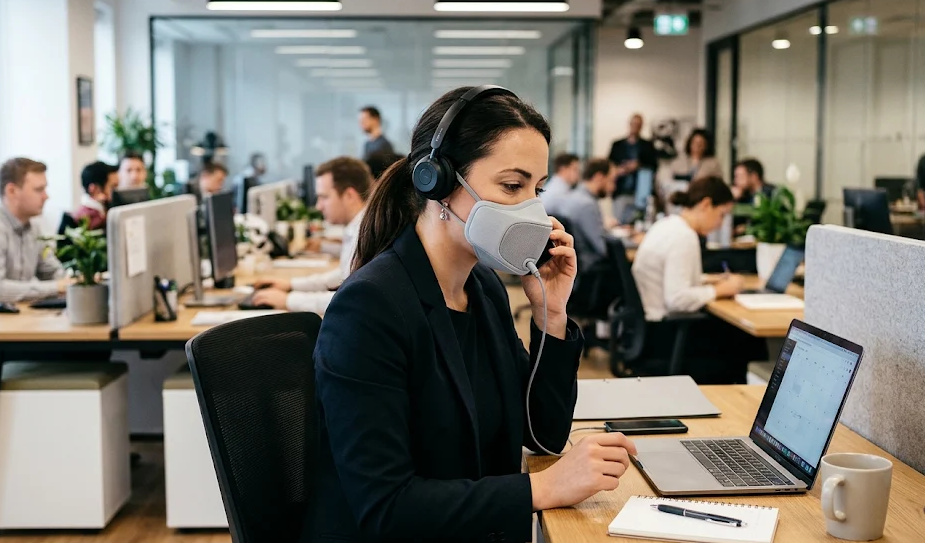
Open-plan offices were designed to encourage collaboration, improve communication, and make better use of shared workspace. However, they also created a persistent problem: having a private conversation without leaving your desk.
Whether discussing confidential business matters, speaking with clients, attending an online meeting, or dictating information to an AI assistant, a normal headset does little to prevent nearby colleagues from hearing what you say.
This is where acoustic masks come in.
An acoustic mask for private calls is a wearable device designed to reduce the amount of speech that escapes into the surrounding environment. Unlike conventional headphones, which primarily improve what the wearer hears, these devices focus on controlling how much of the wearer’s voice other people can hear.
Some models use sound-absorbing materials, specially designed acoustic chambers, and voice-muffling structures. Others combine acoustic isolation with dedicated microphones and wireless connectivity.
Although the technology is still a relatively specialized product category, acoustic masks offer an interesting alternative to traditional office phone booths and meeting rooms.
In this guide, we explain how acoustic masks work, who benefits from using them, which features matter most, and how to evaluate the available options before buying.
1. What Is an Acoustic Mask?
An acoustic mask is a wearable voice-privacy device that fits over or around the mouth and helps reduce the transmission of spoken words into the surrounding environment.
It is sometimes described as a speech privacy mask, voice-muffling mask, voice-capturing mask, or personal acoustic privacy device.
The main objective is straightforward: allow someone to speak into a telephone, computer, or communication system while making their voice less audible or less intelligible to people nearby.
A conventional headset does not accomplish this.
Even if a headset has excellent active noise cancellation, its microphones and speakers primarily manage the audio reaching the user’s ears and the audio transmitted to the other participant. They do not necessarily prevent the user’s actual voice from being heard across the office.
An acoustic mask addresses this separate problem.
How does it work?
Most wearable acoustic privacy systems use one or more of the following principles:
1. Acoustic absorption
Sound-absorbing materials reduce the amount of acoustic energy escaping from the device. Specialized internal structures can also help absorb particular voice frequencies.
2. Physical voice containment
The mask creates a partially enclosed space around the mouth. This helps reduce direct sound transmission into the surrounding room.
3. Microphone positioning
A microphone positioned close to the mouth can capture speech without requiring the wearer to speak loudly.
4. Digital noise processing
Some products combine physical acoustic components with microphone processing to improve the quality of transmitted speech.
5. Passive voice muffling
Certain devices rely primarily on their physical construction rather than electronic sound processing to reduce the audibility of the user’s voice.
The exact implementation differs between manufacturers.
Acoustic mask vs. regular headset vs. office phone booth
| Feature | Regular headset | Acoustic mask | Office phone booth |
|---|---|---|---|
| Reduces surrounding background noise for the wearer | Yes, depending on model | Not necessarily | Yes |
| Reduces how much others hear your voice | Limited | Yes, depending on model | Yes, with suitable construction |
| Portable | Yes | Yes | No |
| Requires installation | No | No | Usually |
| Suitable for confidential calls | Not by itself | Partially, depending on performance | Generally better |
| Allows desk-based calls | Yes | Yes | No, unless installed nearby |
| Can be used while travelling | Yes | Yes | No |
| Typical cost | $50–$300 | $139–$300 | Several thousand dollars |
Important distinction: An acoustic mask does not automatically make a conversation completely confidential. Its effectiveness depends on the device, how well it fits, speaking volume, background noise, and the distance between the wearer and other people.
For highly sensitive conversations, a properly designed private room remains the more dependable option.
2. Who Needs an Acoustic Mask?
Acoustic masks are most useful for people who frequently need to communicate verbally in environments where private conversations are difficult.
They are not essential office equipment for everyone. Their value depends on how often someone makes calls, how sensitive those conversations are, and whether alternative private spaces are available.
2.1 Open-plan office employees
This is arguably the most obvious target audience.
Employees working in shared offices often have to make calls while colleagues are working nearby. Even when the conversation is not particularly sensitive, constantly worrying about disturbing others can make communication uncomfortable.
An acoustic mask can help reduce the amount of speech that travels into the surrounding workspace.
Best for:
- Employees making frequent telephone calls.
- Hybrid workers without access to private meeting rooms.
- Professionals sharing desks or collaborative workspaces.
- People who regularly participate in online meetings.
2.2 Sales professionals and customer support teams
Sales representatives, account managers, and customer support employees frequently communicate with customers throughout the day.
Some conversations involve names, contact information, account details, or commercial discussions that should not be casually overheard.
An acoustic mask can provide an additional layer of speech privacy while allowing employees to remain at their desks.
However, businesses should not treat a wearable mask as a replacement for their confidentiality policies or secure communication procedures.
2.3 Managers and executives
Managers often need to discuss internal matters, staffing decisions, business performance, and commercial plans.
In a busy office, finding an available meeting room for every short conversation is not always practical.
A speech-muffling device may be useful for less sensitive discussions when leaving the workspace is inconvenient.
For genuinely confidential executive conversations, a dedicated private room is still preferable.
2.4 Remote and hybrid workers
People working from shared apartments, coworking spaces, libraries, or other public environments may also benefit.
For example, someone attending a work meeting from a shared workspace might want to communicate without disturbing other visitors.
The same applies to people sharing a home office with family members or roommates.
2.5 Developers and AI-assisted professionals
An emerging use case involves voice interaction with AI tools.
Developers, researchers, writers, and other professionals increasingly use speech-to-text software and voice-controlled assistants.
An acoustic mask can potentially make it easier to dictate instructions without broadcasting every spoken prompt to nearby colleagues.
This is particularly relevant in open offices where employees frequently use voice input.
2.6 Who probably does not need one?
An acoustic mask may not be worth the investment if:
- You make only occasional calls.
- Your office already provides sufficient private meeting rooms.
- You normally communicate through text.
- You work in a private office.
- You are uncomfortable wearing equipment around your mouth.
- Your primary problem is hearing background noise rather than preventing others from hearing you.
In these situations, a good headset, a quiet room, or an acoustic desk divider may offer better value.
3. Best Acoustic Masks and Voice-Privacy Devices to Consider
The market for wearable acoustic privacy products is relatively small. However, several manufacturers have developed devices with different approaches to reducing voice transmission.
For this comparison, we consider three notable products:
- Hushme Classic: A dedicated speech-privacy mask with an integrated microphone and headset functionality.
- Shiftall mutalk 2: A soundproof wireless microphone designed to reduce voice leakage.
- Skyted Whisper 320: A wearable voice-capture headset designed for discreet speech in shared environments.
One important distinction: not every product in this comparison is a traditional mask. Some are better described as acoustic microphones or voice-privacy headsets.
Top products compared
| Product | Product category | Listed price (USD) | Main technology | Battery life |
|---|---|---|---|---|
| Hushme Classic | Acoustic voice mask | $229 | Physical voice muffling and integrated microphone | Up to 15 hours talk time |
| Shiftall mutalk 2 | Acoustic microphone mask | $199 | Sound-isolating microphone and enclosed mouthpiece | Approximately 10 hours |
| Skyted Whisper 320 | Discreet voice headset | Approximately $230 | Close-range voice capture and discreet speaking | Check manufacturer specifications |
Prices are indicative. The Skyted price is an approximate USD conversion of its €199 listed price, not a USD retail quotation. Availability differs by market. Manufacturer listings for Hushme Classic and mutalk 2 have shown out-of-stock or sold-out status.
3.1 Hushme Classic – Best-known dedicated voice mask
Indicative price: $229
Hushme Classic is one of the most recognizable products in the acoustic mask category.
It was designed specifically for people who want to make calls in shared environments without allowing everyone nearby to hear their conversations.
The device combines a mouth-covering acoustic structure with an integrated microphone and wireless headset functionality.
Its main selling point is that it addresses both sides of the communication problem: capturing the user’s voice for the other caller and reducing the sound escaping into the surrounding environment.
Key features:
- Physical voice-muffling construction.
- Integrated microphone.
- Bluetooth connectivity.
- Wired connection through a 3.5 mm audio connection.
- Replaceable mouthpiece components.
- Up to 15 hours of advertised talk time.
- Approximately 10 dB advertised sound reduction.
Advantages
The dedicated voice-mask design makes it particularly relevant to people who regularly make calls in shared offices.
It also supports different connection arrangements, including the use of an external headset.
The replaceable mouthpiece is another useful feature because hygiene is an important consideration for equipment worn directly against the face.
Disadvantages
The device is relatively unusual in appearance and may attract attention in a professional office.
Its physical fit also matters considerably. Poor contact around the mouth can reduce its effectiveness.
Another consideration is availability: the manufacturer’s product page lists the $229 model but has displayed it as out of stock.
SEE2GET editorial rating: 8.4/10
| Evaluation category | Rating |
|---|---|
| Speech privacy potential | 8.5/10 |
| Comfort and ergonomics | 8.0/10 |
| Connectivity | 8.5/10 |
| Portability | 8.5/10 |
| Everyday office practicality | 8.0/10 |
| Overall | 8.4/10 |
Best for: Professionals looking for a purpose-built acoustic voice mask rather than a conventional headset.
Product information: Official Hushme website.
3.2 Shiftall mutalk 2 – Best for computer-based communication
Listed US price: $199
The mutalk 2 takes a slightly different approach.
Developed by Shiftall, it is described as a soundproof wireless microphone that isolates the user’s voice and reduces the amount of surrounding noise entering the microphone.
Rather than functioning like a conventional headset, the device uses an enclosed mouthpiece that the user wears over the lower face.
It is designed for video conferences, voice chats, online communication, and other situations where speaking aloud could disturb nearby people.
One particularly interesting feature is its included nose-cover mouth pad.
The manufacturer explains that the additional component helps produce a more natural-sounding voice compared with using the regular mouth pad alone.
Key features:
- Bluetooth 5.3.
- Dedicated USB wireless dongle.
- USB audio connection.
- Approximately 10-hour battery life.
- USB-C charging.
- 188 g device weight.
- Removable and washable mouth pads.
- Dedicated headband.
- Included nose-cover mouth pad.
Advantages
The connection flexibility makes mutalk 2 interesting for office computer users.
The dedicated wireless dongle and USB audio connection offer alternatives to Bluetooth, which can be useful when working with conferencing applications.
Its removable mouth components are also beneficial for regular use.
Another advantage is that it has a relatively compact design.
Disadvantages
The product is still a mouth-covering device, so users should consider comfort and appearance before purchasing.
Bluetooth microphone quality can also differ from wired or dongle-based performance.
For professional meetings, it is worth testing the device with the actual conferencing software and computer before relying on it.
Availability is another consideration: the manufacturer’s US store has listed the product at $199 but displayed it as sold out.
SEE2GET editorial rating: 9.0/10
| Evaluation category | Rating |
|---|---|
| Speech privacy potential | 9.0/10 |
| Comfort and ergonomics | 8.5/10 |
| Connectivity | 9.5/10 |
| Portability | 9.0/10 |
| Everyday office practicality | 8.5/10 |
| Overall | 9.0/10 |
Best for: People who regularly use computers for video conferencing, voice communication, and AI-assisted workflows.
Product information: Official Shiftall mutalk 2 website.
3.3 Skyted Whisper 320 – Best alternative for discreet voice communication
Indicative price: approximately $230
Skyted approaches discreet communication from a slightly different direction.
Its Whisper 320 is a wearable voice-capture headset designed to let people speak quietly while maintaining clear communication with the person or software receiving their voice.
The manufacturer describes its intended experience as allowing the user to whisper or speak in an ultra-low voice while the other participant hears them clearly.
Nearby people should hear a murmur rather than intelligible words.
This is particularly interesting for modern office environments where employees increasingly use voice-controlled software, AI assistants, and online collaboration platforms.
Key features:
- Directional and omnidirectional microphones.
- USB-C wireless dongle.
- Compatible with major communication applications.
- Supplied carrying case.
- Multiple ear-tip sizes.
- USB-C charging.
Advantages
The Whisper 320 is interesting for people who prefer a less conventional mask-style solution.
Its focus on low-volume speaking makes it particularly relevant to voice dictation and AI interaction.
The manufacturer also lists compatibility with platforms including Zoom, Microsoft Teams, Google Meet, WhatsApp, ChatGPT, and Claude.
Disadvantages
It is important to understand that this is not the same type of physical acoustic mask as Hushme or mutalk 2.
Buyers should evaluate how effectively it limits speech intelligibility at the distances relevant to their workplace.
Its listed European price is €199 including VAT. The approximate $230 comparison price is a currency conversion rather than an advertised US price.
SEE2GET editorial rating: 8.6/10
| Evaluation category | Rating |
|---|---|
| Discreet communication potential | 9.0/10 |
| Comfort and ergonomics | 9.0/10 |
| Connectivity | 9.0/10 |
| Portability | 9.0/10 |
| Everyday office practicality | 8.0/10 |
| Overall | 8.6/10 |
Best for: Professionals who want to communicate quietly with computers, AI assistants, and conferencing applications without necessarily wearing a conventional acoustic mask.
Product information: Official Skyted Whisper 320 website.
3.4 Which product is the best overall?
There is no universal winner because these devices address slightly different needs.
| Buying priority | Recommended product | Reason |
|---|---|---|
| Traditional acoustic mask | Hushme Classic | Purpose-built voice-muffling design |
| Computer communication | mutalk 2 | USB, Bluetooth and dedicated dongle options |
| Quiet AI interaction | Skyted Whisper 320 | Designed for low-volume voice capture |
| Flexible office connectivity | mutalk 2 | Multiple connection methods |
| Less conventional wearable design | Skyted Whisper 320 | Headset-oriented approach |
Our editorial verdict: Shiftall mutalk 2 is the strongest overall feature proposition on paper, while Hushme Classic is the more direct choice for someone specifically looking for an acoustic mask.
These are specification-based editorial assessments, not results from independent laboratory testing or hands-on product reviews. The ratings should not be interpreted as measured sound-reduction scores.
4. How to Choose the Best Acoustic Mask for Office Use
Choosing an acoustic mask requires a different approach from buying ordinary headphones.
Sound quality is important, but it is not the only consideration. A device can provide excellent microphone performance while offering insufficient privacy from people sitting nearby.
The best purchasing decision should balance speech reduction, microphone quality, comfort, connectivity, hygiene, and overall practicality.
Here are the most important factors to evaluate.
4.1 Speech reduction performance
This should be the first consideration.
The primary purpose of an acoustic mask is to reduce the amount of speech escaping into the surrounding environment.
Manufacturers sometimes advertise sound reduction in decibels (dB). However, buyers should be careful when comparing these numbers.
A decibel figure is meaningful only when the measurement conditions are understood.
For example, manufacturers may use different testing distances, frequencies, measurement environments, and methods.
When evaluating a product, look for:
- Independently verified acoustic measurements.
- Speech intelligibility testing.
- Performance at realistic office distances.
- Results across different speaking volumes.
- Information about sound leakage around the mask.
A reduction in overall sound level does not necessarily mean that spoken words become unintelligible.
For office privacy, the latter is particularly important.
4.2 Microphone quality
A good acoustic mask must provide two things simultaneously:
- Reduce the amount of speech heard by nearby people.
- Deliver understandable speech to the person on the other end of the call.
Poor microphone performance can make conversations frustrating.
Look for directional microphones, appropriate microphone positioning, and compatibility with commonly used conferencing applications.
Ideally, the device should capture normal conversational speech without requiring you to raise your voice.
4.3 Comfort and ergonomics
An acoustic mask sits directly against the face, making comfort especially important.
Unlike ordinary headphones, which can be removed easily between calls, a mask-style device can feel restrictive if its shape and materials are poorly designed.
Pay attention to:
- Total device weight.
- Pressure around the mouth and nose.
- Adjustable straps.
- Breathability.
- Soft contact materials.
- Ease of putting on and removing the device.
- Compatibility with glasses.
- Comfort during longer conversations.
If possible, try the product before purchasing.
A device that provides impressive acoustic performance but becomes uncomfortable after a short period is unlikely to be useful for everyday office work.
4.4 Hygiene and maintenance
Because acoustic masks come into contact with the face, hygiene should be a major purchasing consideration.
Look for products with removable mouthpieces, washable cushions, replaceable contact materials, and accessible cleaning instructions.
This becomes particularly important in offices where equipment may be shared between employees.
Before buying, establish whether replacement components are available and how much they cost.
Avoid assuming that every internal component can be washed. Follow the manufacturer’s cleaning instructions.
4.5 Connectivity and compatibility
Modern office communication involves several devices and applications.
Your acoustic mask should work with the equipment you actually use.
Consider the following:
| Connection type | Main advantage | Potential limitation |
|---|---|---|
| Bluetooth | Convenient wireless operation | Microphone quality and latency can vary |
| USB-C | Direct computer connection | Requires a suitable cable or port |
| USB wireless dongle | Dedicated wireless connection | Requires an available compatible port |
| 3.5 mm audio | Useful for compatible traditional equipment | Increasingly uncommon on modern devices |
Also check compatibility with:
- Windows computers.
- macOS computers.
- Android smartphones.
- iPhones and iPads.
- Microsoft Teams.
- Zoom.
- Google Meet.
- Other communication applications.
Application compatibility should be verified rather than assumed from general Bluetooth or USB support.
4.6 Battery life
Battery capacity matters if you regularly make calls throughout the working day.
For occasional calls, approximately 8–10 hours of advertised operating time may be sufficient.
For intensive daily use, look for longer battery life or a device that supports wired operation while charging.
Remember that advertised battery figures are not always equivalent to real-world continuous microphone usage.
4.7 Appearance and workplace acceptance
This is an unusual but important factor.
Acoustic masks can attract attention because they look different from conventional office equipment.
Some employees may feel comfortable wearing one during meetings, while others may prefer a less noticeable device.
Consider whether the design is appropriate for:
- Client-facing video conferences.
- Shared office environments.
- Reception areas.
- Professional presentations.
- Frequent business travel.
For some organizations, a dedicated phone booth may be a more socially acceptable solution.
4.8 Price and long-term ownership costs
The initial purchase price is only part of the overall investment.
Consider replacement mouthpieces, cushions, charging accessories, warranty coverage, and availability of spare parts.
For businesses purchasing several units, replacement components and maintenance can become significant expenses.
A slightly more expensive device may offer better long-term value if it is more comfortable, easier to clean, and supported by the manufacturer.
5. Acoustic Mask Buying Checklist
The following checklist can help narrow down the options.
| Buying criterion | Importance | What to look for |
|---|---|---|
| Speech privacy | Critical | Verified reduction in speech intelligibility |
| Microphone quality | Critical | Clear voice transmission |
| Comfort | High | Lightweight design and adjustable fit |
| Hygiene | High | Removable and washable mouthpieces |
| Connectivity | High | Compatibility with your computer and phone |
| Battery life | Medium | At least 8–10 hours advertised |
| Portability | Medium | Compact design and protective case |
| Noise processing | Medium | Effective microphone noise handling |
| Replacement parts | Medium | Available mouthpieces and cushions |
| Warranty | High | Clear coverage and support policy |
Our recommendation is to prioritize speech privacy, microphone performance, and comfort before considering secondary features.
6. Acoustic Masks vs. Alternative Office Privacy Solutions
An acoustic mask is not the only way to make private calls in a shared workplace.
In some situations, a conventional solution may offer better value.
Here are the main alternatives.
| Solution | Typical price (USD) | Privacy potential | Portability | Best application |
|---|---|---|---|---|
| Acoustic voice mask | $139–$229 | Moderate to high, depending on product | Excellent | Desk-based calls |
| Acoustic voice headset | Approximately $230 | Depends on speech-reduction performance | Excellent | Quiet voice communication |
| Noise-cancelling headset | $50–$300 | Low for preventing voice leakage | Excellent | Hearing and microphone noise management |
| Desktop acoustic screen | $50–$250 | Limited to moderate | Good | Reducing nearby sound transmission |
| Portable office booth | $1,000–$5,000+ | Generally higher | Limited | Regular private conversations |
| Dedicated office phone booth | $3,000–$10,000+ | Generally high | Poor | Confidential office calls |
Alternative product prices are broad indicative budgeting estimates, not verified quotations. Actual costs depend on size, specifications, manufacturer, and installation.
6.1 Noise-cancelling headphones
Noise-cancelling headphones are probably the most common alternative.
They help users concentrate by reducing unwanted background sounds.
However, active noise cancellation primarily affects the sound reaching the wearer. It does not prevent colleagues from hearing the wearer’s voice.
They are useful when the main problem is distraction rather than speech privacy.
6.2 Acoustic desk dividers
Acoustic desk screens are panels positioned between workstations.
They can reduce direct sound transmission and help control reflections in shared offices.
Their effectiveness depends on height, material, positioning, and surrounding room acoustics.
They are not designed to make individual conversations confidential.
6.3 Office phone booths
A dedicated office phone booth is a more comprehensive alternative.
These enclosed spaces are designed for individual calls, video conferences, and focused work.
Their advantages include greater separation from the surrounding environment and the ability to speak naturally without wearing a mask.
Their main disadvantages are purchase cost, installation requirements, and the amount of floor space they occupy.
For organizations with frequent confidential conversations, phone booths may represent a better long-term investment.
7. Common Mistakes When Buying an Acoustic Mask
Even a well-designed device can disappoint if buyers misunderstand what it can do.
Here are some common mistakes to avoid.
Mistake 1: Assuming complete silence
No wearable acoustic mask should automatically be considered completely silent.
Some sound may escape, particularly when the device does not fit properly or the wearer speaks loudly.
Mistake 2: Confusing noise cancellation with voice privacy
A headset that cancels background noise does not necessarily prevent other people from hearing your speech.
These are two different functions.
Mistake 3: Ignoring microphone performance
A mask that muffles speech effectively but produces poor audio for the recipient can make professional conversations difficult.
Mistake 4: Buying without checking compatibility
Some products work better through dedicated USB dongles than through standard Bluetooth connections.
Check the manufacturer’s compatibility information before purchasing.
Mistake 5: Ignoring hygiene
Removable and washable mouthpieces are particularly useful for equipment intended for repeated daily use.
Mistake 6: Relying on marketing claims
Statements such as “100% private,” “completely silent,” or “impossible to overhear” should be treated cautiously.
Look for independent measurements and real-world speech intelligibility testing.
Mistake 7: Forgetting workplace confidentiality requirements
An acoustic mask is a privacy aid, not a substitute for secure meeting rooms, appropriate data-handling procedures, or organizational confidentiality policies.
8. How to Test an Acoustic Mask Before Buying
If possible, arrange a demonstration or use a retailer’s return policy to evaluate the device.
A practical test should involve both the wearer and someone positioned at a realistic office distance.
We recommend evaluating the following:
| Test | What to evaluate |
|---|---|
| Normal speaking test | Whether the microphone captures ordinary speech clearly |
| Low-volume speaking test | Whether the recipient can understand quiet speech |
| Speech leakage test | How intelligible the conversation is to someone nearby |
| Comfort test | Whether the device remains comfortable during a typical call |
| Connectivity test | Whether the microphone works correctly with your computer |
| Application test | Whether it works with your regular meeting software |
| Hygiene test | Whether contact components are easy to clean |
| Battery test | Whether the device lasts through your normal usage pattern |
A simple office privacy evaluation
For a meaningful comparison, use the same short spoken passage, speaking volume, and approximate listening distance with each device.
Ask an independent listener to assess whether the words are understandable.
Repeat the evaluation under different office conditions.
For example:
- A quiet office.
- A moderately noisy workspace.
- A busy open-plan environment.
This matters because background noise can make speech harder to understand even when the acoustic mask itself has not changed.
Do not treat an informal listening test as a security certification. For sensitive business information, use an appropriately private room.
9. Final Verdict: Are Acoustic Masks Worth Buying?
Acoustic masks solve a relatively specific but increasingly relevant problem.
Modern workplaces are becoming more flexible, and employees increasingly communicate from shared offices, coworking spaces, and other environments where complete privacy is difficult to achieve.
Traditional headphones help people hear better, but they do not necessarily prevent others from hearing what they say.
Acoustic masks address this gap by reducing the amount of speech escaping into the surrounding environment.
For people who make frequent calls, dictate information, or interact with voice-controlled applications, this technology can be worth considering.
Our recommendations
| User type | Our recommendation |
|---|---|
| Open-plan office employee | Hushme Classic |
| Frequent computer-based caller | Shiftall mutalk 2 |
| AI voice interaction user | Skyted Whisper 320 |
| Business with highly confidential calls | Dedicated private phone booth |
| Occasional caller | Conventional headset and quiet meeting space |
Final SEE2GET assessment
The Shiftall mutalk 2 is our leading specification-based recommendation because of its connection flexibility, dedicated wireless dongle, removable mouth components, and relatively accessible $199 listed US price.
The Hushme Classic remains a relevant option for buyers specifically interested in a purpose-built acoustic voice mask.
The Skyted Whisper 320 offers an interesting alternative for people who prioritize discreet voice interaction over conventional mask-style construction.
However, availability is an important purchasing consideration. Buyers should verify stock, warranty terms, shipping costs, and return policies before placing an order.
Ultimately, acoustic masks should be viewed as an additional layer of workplace privacy rather than a complete replacement for private meeting spaces.
For ordinary office conversations, they may offer a convenient solution. For genuinely confidential discussions, a properly designed private room remains the better choice.
10. Frequently Asked Questions (FAQ)
What is an acoustic mask for private calls?
An acoustic mask is a wearable device designed to reduce the amount of speech escaping into the surrounding environment. It typically uses sound-absorbing materials, an enclosed mouthpiece, or specialized microphone technology.
Do acoustic masks completely hide your voice?
No. Their effectiveness depends on the design, fit, speaking volume, and surrounding environment. Some devices reduce speech audibility considerably, but complete speech privacy should never be assumed.
Can I use an acoustic mask with Microsoft Teams and Zoom?
Many devices support computer-based communication, but compatibility depends on their connection technology and operating-system support. Check the manufacturer’s specifications before purchasing.
Are acoustic masks comfortable to wear?
Comfort varies between models. Weight, face contact materials, adjustable straps, and ventilation all influence the experience.
It is worth testing a device before committing to regular use.
Are acoustic masks better than noise-cancelling headphones?
They serve different purposes.
Noise-cancelling headphones primarily reduce the background noise reaching the wearer. Acoustic masks aim to reduce the amount of speech reaching nearby people.
Some users may benefit from combining both technologies.
Can acoustic masks be used for confidential business calls?
They can provide additional speech privacy, but they should not be treated as guaranteed protection against eavesdropping.
For highly sensitive conversations, use a properly private meeting space.
How much does a good acoustic mask cost?
The products covered in this guide have indicative prices ranging from $199 to approximately $230, with Hushme Classic listed at $229.
The actual purchase price depends on availability, shipping, and applicable taxes.
Do acoustic masks work for AI voice assistants?
Yes, some models are designed for voice interaction with computers and AI assistants.
However, buyers should check application compatibility, microphone performance, and whether the device can capture quiet speech accurately.
Are acoustic masks suitable for shared offices?
Yes. Shared offices are among their most relevant use cases, particularly when employees need to make frequent calls without disturbing colleagues.
What should I prioritize when choosing one?
Start with speech privacy performance, microphone clarity, comfort, hygiene, and connectivity. These factors have a much greater impact on everyday usability than cosmetic features.
About SEE2GET
SEE2GET is an independent technology and product review magazine helping readers make smarter buying decisions. Through in-depth reviews, comparisons, buying guides, and practical how-to articles, we explore technology across Gadgets, Living, Wellness, Hardware, and Outdoor categories.
Our editorial approach focuses on practical product performance, transparent comparisons, and useful information that helps readers understand what they are buying before making a purchasing decision.